
Nia broke the spaghetti in half before Marcus could stop her.
“Oh,” he said. “Okay. So that’s who you are.”
“It fits better.”
“It fit fine. It’s been fitting. People been fitting spaghetti in pots for a thousand years without anybody snapping it.”
“Mom breaks it.”
“Your mother is a wonderful woman with some problems.”
Nia dropped the second handful in and took the wooden spoon off the counter like it had been issued to her. She was eleven, and she had recently decided that stirring was the best job in the kitchen. As far as Marcus could tell, it came with the most authority and the least work.
He browned the ground turkey and shook Old Bay over it. Nia watched him do it with open suspicion.
“That’s for crabs.”
“It’s for whatever I say it’s for.”
“That’s not how seasoning works.”
“You’re eleven. You don’t know how anything works. Stir.”
His phone buzzed on the counter. Dana from work: Any chance you can take the 9am with facilities tomorrow? Dentist. I owe you. He wrote back Got it. Dana owed him for about eleven things by now. He had stopped keeping count, which meant he knew it was eleven.
Then his cousin Tre: u still got the ladder
Garage, Marcus wrote. Code’s the same.
Under the texts, the little red 1 on the phone icon had been sitting there since Wednesday. He turned the phone face down and went looking for the colander.
They ate at the table because Janelle had a rule about the table, and Marcus kept it even at his place, mostly because Nia would report him. The TV in the living room was running highlights from a game he’d already watched. Nia had built a small wall of parmesan from the green can on one side of her plate.
“Do you believe God talks to people?”
Marcus twirled his fork. “Where’s this coming from?”
“Brianna’s moving to Charlotte because God told her mom.”
“God told her mom Charlotte. Specifically.”
“That’s what Brianna said.”
“Charlotte’s nice. They got a good airport.”
Nia looked at him. She had Janelle’s version of that look, the one that just waited until you ran out of room.
“That’s not what I asked.”
“I know it’s not.”
She kept waiting. He took a bite. She kept waiting.
“I think He can,” Marcus said.
“Has He ever talked to you?”
He took his time with the next bite too.
“Long time ago.”
“What did He say?”
“Nia. You got sauce on your eyebrow. How do you get sauce on your eyebrow?”
She wiped the wrong one. He let her.
Janelle called while Nia was in the shower.
“Did she eat anything green?”
“There was oregano.”
“Marcus.”
“There was a salad in the general vicinity.”
“Her permission slip is in the front pocket of her bookbag. It has to go back tomorrow or she can’t go on the Air and Space trip.”
“Front pocket.”
“Sign it. Don’t look at it and put it back. Sign it.”
“I’ve signed things before.”
“You’ve looked at things before.” A pause. He could hear her kitchen, the TV she kept on for company. “You alright?”
“I’m good.”
“Mm.”
“What’s mm?”
“Nothing. You sound good.”
He didn’t say anything. That had never worked on her either.
“Have you been back up there?” she said.
“Janelle.”
“I’m asking.”
“You’re never just asking.”
“That’s true,” she said. “Tell her I love her. Sign the slip.”
She hung up first. She always had. It used to drive him up the wall. Now, if she ever didn’t, he’d probably call back to check on her.
Nia went to bed at 9:15 after arguing for 9:30 and settling for the extra fifteen minutes she’d been after all along. Marcus signed the permission slip at the table, put it back in the front pocket, and then took it out again to make sure he had actually signed it.
He put WHUR on low. The Quiet Storm. He had a dishwasher. Mostly he used it to store the big pot.
On Tuesday he had driven to the hospital in Largo after work. He parked on the third level of the garage and took the elevator down to the lobby. He told the woman at the desk he was there to see Isaiah Carter. She typed it in and said fourth floor, and he said thank you. Then he did not go to the fourth floor. He bought a bag of Utz from the vending machine by the gift shop, went back up to the third level, sat in the car, ate half the bag, and drove home.
The voicemail came Wednesday.
The plate in his hand was clean. It had been clean for a while.
He was twenty-four when Alicia got pregnant. They had been together two years, long enough to pick out a couch, not long enough for the rest of it. She decided to have an abortion. He told her it was her decision, and he meant it. He drove her, sat in a waiting room with a cooking show nobody was watching, and held her hand in the car afterward. She was sad for a while, and then she was steady, and she told him the truth about both.
She asked how he was doing. She asked more than once, and she asked like she wanted the real answer.
“I’m good,” he said.
He went to work. He went to the gym. He helped Tre move out of his mother’s basement. He was good. Then one Saturday he sat in his car in the Giant parking lot on Branch Avenue with the groceries in the back seat and didn’t start the engine, and he couldn’t have said for how long. The ice cream was soft by the time he got home.
After that came three weeks of not sleeping. Then on a Thursday night he drove to his father’s house without calling first, which he never did.
His father opened the door with his reading glasses pushed up on his head.
“Marcus. Everything alright?”
“Yeah. I was just in the area.”
His father looked at him a second longer than usual. “You eat? There’s chicken.”
The dining room table was covered the way it was every Thursday: commentaries, a legal pad, the good lamp pulled close. His father moved two books to the far end to make room. He fixed Marcus a plate. Marcus didn’t touch it.
It took him a while to start. His father waited. People brought Isaiah Carter things every Sunday, and he knew how to wait.
Marcus told him. Alicia. The test. The decision. The waiting room. The car. He kept his eyes on the legal pad the whole time, on his father’s handwriting and the word Romans underlined twice.
His father put his pen down.
“You took her there?”
It wasn’t louder. It was flatter. Marcus had heard that voice from the third pew his whole life. He had never had it pointed at him across a dinner table.
“Yeah.”
“You drove her. And you sat there.”
“She asked me to.”
“And you let her do that.”
“I didn’t let her do anything. It was her decision.”
“You were her man.”
“Dad...”
“You were her man, Marcus. That was your child too.”
Marcus looked at the chicken.
His father sat back and rubbed his face with both hands. “I raised you better than that,” he said, mostly into his palms. “I know I did.”
“This is why I didn’t want to tell you.”
“Then why did you?”
“Because you’re my father.”
“Exactly.” His father leaned forward. “Which is why I’m not going to sit here and tell you what you did was alright.”
“I didn’t ask you to.”
“Then what are you asking me?”
Marcus opened his mouth. Nothing came. The lamp had a low buzz he had never noticed before.
“I keep thinking about it,” he said finally. “I’m at work and I’m fine, and then I’m...” He moved his hand, like the rest of the sentence was somewhere over by the china cabinet. “I can’t sleep.”
His father nodded slowly, like something had finally come clear.
“That’s conviction. What you’re carrying right there. That’s God.”
“You don’t know what I’m feeling.”
“I know what conviction looks like. I’ve been looking at it thirty years.”
“No. You know what you think everything means.”
His father’s jaw worked. For a second he looked older than he was. Then he didn’t.
“You can be as angry with me as you want,” he said quietly. “But you can’t run from God because you don’t like what He’s saying.”
“I’m not running.”
“You drove over here at nine o’clock on a Thursday night. Something’s after you.”
“I came to see you.”
“And I’m telling you the truth, son. That’s what a father does.”
Marcus pushed his chair back. “I should go.”
“Sit down.”
“I’m not sitting down.”
“Then we’ll pray standing up.”
“I don’t want to pray, Dad.”
“I know you don’t.” His father was already coming around the table. “That’s how I know we need to.”
Marcus could have stepped back. He didn’t. His father put a hand on his head. It was heavy and warm, the same hand Marcus had felt at the altar every Sunday he could remember. His father’s voice changed the way it did at church, lower and slower, every word set down carefully.
“Father God, You know my son. You knew him before I did. Lord, I’m asking You to work on his heart tonight. Don’t let him run from this conviction. Don’t let him harden. Bring him to repentance, Lord, and meet him there with Your forgiveness. Make him the man You called him to be...”
Marcus kept his eyes open. He looked at the china cabinet, at the good glasses nobody was allowed to use. He stood under his father’s hand and listened to his father explain him to God.
Nobody interrupted.
“...in Jesus’ name.”
“Amen,” Marcus said, because you said amen.
At the door, his father handed him the plate, wrapped in foil.
“You didn’t eat.” He put a hand on Marcus’s shoulder. “I love you. You know that.”
“I know.”
“You need to take this to God.”
Marcus looked past him, back into the dining room. The lamp was still on. The Bible was still open on the table, next to the empty chair where he’d been sitting.
“Yes, sir.”
He sat in the car in front of the house until the porch light went off. The chicken rode home on the passenger seat. He didn’t take it anywhere.
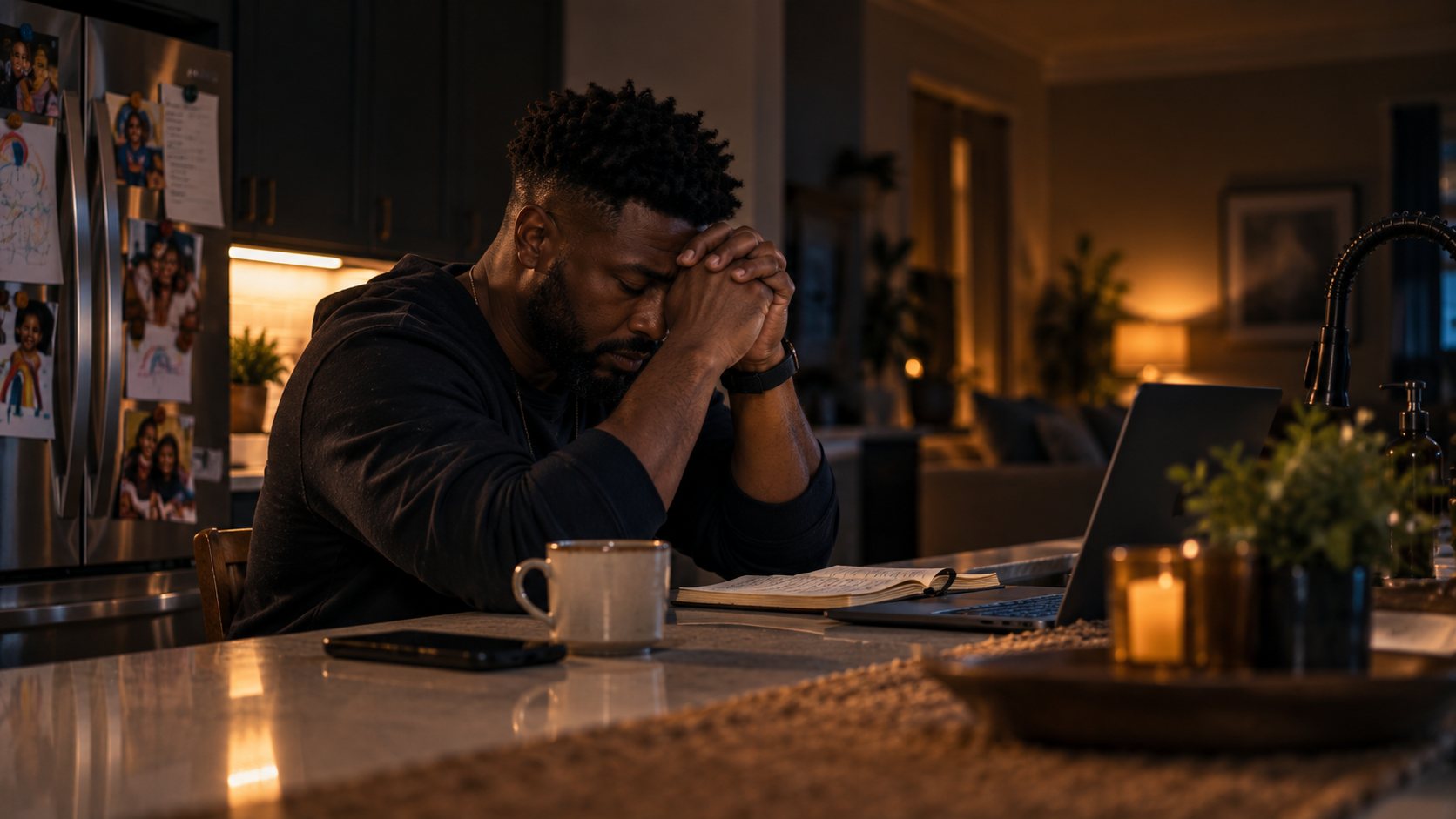
The radio moved into something slow with a lot of saxophone. Marcus turned the water off, then back on. Standing at a sink with the water off felt too much like doing something.
“So,” he said.
Nothing happened, which seemed fair.
He rinsed the plate again.
“You still there?”
The station went to commercial. A man with a very big voice wanted him to come on down to Bowie and talk about a truck.
Marcus laughed once, through his nose.
“I don’t even know if I’m talking to You or talking to myself.” He put the plate in the rack. Picked it back up. “Probably myself. I’m easier to talk to.”
The truck man finished. A woman came on, quiet, back to the music.
“He’s sick. You know that. I figure You know that.” He turned the plate over, like there might be something on the back. “I went up there Tuesday. Got as far as the lobby. Bought some chips.”
He set the plate down. He dried his hands on the towel over his shoulder and then just stood there holding the towel.
“I don’t want to go.”
“Daddy?”
Nia was in the doorway in one of his old T-shirts, which came down to her knees.
“I need water.”
“Cups are where cups always are.”
She didn’t move toward the cups. She was looking at him the way she looked at a math problem she suspected was lying to her.
“Are you okay?”
The answer was right there. He’d been giving it for thirty-nine years. It came up on its own, like a reflex.
“I’m...”
He stopped.
“I’m not,” he said.
Nia thought about that. Then she crossed the kitchen, put her arms around his middle, and pressed her face into his shirt, which was wet down the front from the sink.
“You’re all wet,” she said into it.
“Yeah.”
She held on longer than he expected. Then she let go, got a cup, filled it at the fridge, drank half of it standing right there, said “Night,” and went back upstairs. He heard her door close. Then he heard it open again.
“I’m leaving my cup up here!”
The door closed.
He sat at the table and turned the phone over. The red 1 was still there. He played the voicemail on speaker, low.
A breath. Then his father’s voice, thinner than it should have been.
“Marcus... it’s Dad. They said you came by the hospital earlier this week.” A long pause. Something beeped in the background. “I don’t know if you’ll come back. I’d like to see you.” Another pause. “Alright.”
That was all of it. He played it again, and it was still all of it.
“What am I supposed to do with that?” Marcus said to the kitchen.
He sat there a while longer. He left the phone face up.
In the morning, Nia regarded her cereal.
“This is the fake kind.”
“It’s the same kind. Different box.”
“It tastes like the box.”
“Then eat it faster so you taste it less.”
She ate. He packed her lunch and put an extra granola bar in it, because the trip to the museum involved a bus and he had been on buses with eleven-year-olds.
“I heard you talking last night,” Nia said, with her mouth full.
“You were supposed to be asleep.”
“I was getting water. Before the water.” She chewed. “Were you talking to God?”
He put the lid on the peanut butter.
“Did God talk to you?”
“I don’t know,” Marcus said.
He screwed the lid on tighter than it needed.
“But I talked to Him.”
“Cool,” Nia said, and kept eating. After a minute she said, “Did you sign the slip or did you look at it?”
“I signed it.”
“Mom said you’d look at it.”
“Your mother is a wonderful woman.”
“With some problems,” Nia said.
“Eat your fake cereal.”
He dropped her at school at 8:20 and watched her walk in without looking back. Somewhere between third and fourth grade, she had stopped looking back.
At 8:52 he was parked in the garage at work with the engine off. The facilities meeting was at nine. Dana had texted a tooth emoji and a heart.
He opened his contacts. On Wednesday night he had saved the number for the fourth floor under HOSPITAL, in all capitals, as if it might try something.
His thumb hovered over it.